

Custom Home Renovations: The Top Priority for Occupied Homes in Virginia
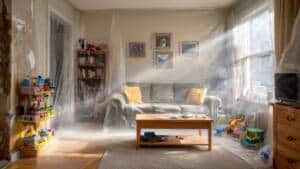
Dust is the nemesis of the live-in renovator. Beyond being a nuisance, it poses health risks, can contaminate belongings, and may compromise the quality of your new finishes. Effective dust management requires a multi-layered strategy.
1. Source Control
The best way to manage dust is to prevent it from becoming airborne in the first place. Professionals use:
HEPA-Filtered Tools: Sanders and saws connected directly to HEPA vacuums capture dust immediately as it is generated.
Water-suppression techniques: Using water to suppress dust when cutting tile, concrete, or masonry prevents hazardous respirable dust from circulating.
Off-site cutting: Cutting materials in a controlled workshop eliminates a massive amount of debris from being created on-site.
2. Containment Barriers
Simple plastic sheeting alone won’t suffice. True containment requires:
Airlock entries: Creating “airlocks” with temporary zippered doors allows workers to move in and out without breaking the seal.
Heavy-duty plastic barriers: Heavy-gauge sheeting is used to seal off stairwells, doorways, and HVAC vents to prevent dust from traveling via ductwork.
3. Negative Air Pressure
This is the gold standard for live-site safety. By using a air scrubber with negative pressure, we create a pressure differential inside the work zone. This ensures that when doors are opened, air flows into the contained zone rather than dust escaping into your living quarters.
Prioritizing Safety During an Occupied Renovation in Virginia
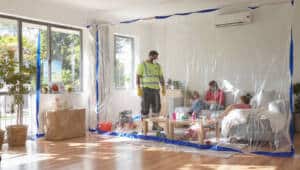
When a property is occupied, safety protocols expand beyond protecting only the workers to protecting the homeowners—including children, pets, and the elderly.
Dangerous Substances
If your home was built decades ago, disturbing paint or insulation may release lead or asbestos. Do not DIY this. A professional renovation team will perform assessments before demolition. If found, certified removal experts must handle removal to ensure the air is breathable for occupancy.
Electrical and Structural Integrity in Virginia
Live-site renovations require strict protocols of utilities.
Circuit isolation: Electrical circuits being worked on must be locked off and clearly labeled to prevent accidental re-energization.
Structural shoring: If walls are being removed, temporary structural shoring are installed before demolition begins to ensure the home remains stable.
Emergency Preparedness
A clear path to escape routes must be maintained at all times. Fire extinguishers should be staged in accessible locations, and the family should be briefed on the location of utility cutoffs (water, gas, power) before the project begins.
Living Through the Chaos: The Role of Temporary Facilities in Virginia
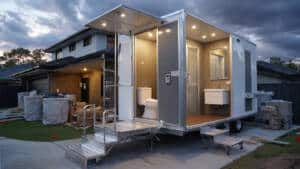
One of the biggest stressors of a live-site renovation is the loss of critical living spaces. A thoughtful renovation plan always includes a strategy for temporary facilities to keep your life running smoothly.
Camp Kitchens
If your main kitchen is under construction, a “camp kitchen” is essential. This typically involves:
Dedicated Space: Setting up in a dining room, garage, or laundry room.
Essential Appliances: A portable induction cooktop, microwave, toaster oven, and a bar fridge.
Water access: Ensuring access to a utility sink or bathroom sink for washing dishes, with a basin to prevent food debris from clogging plumbing.
Temporary Bathrooms
Losing a bathroom can be the most challenging aspect of a renovation.
Phased construction: If you have multiple bathrooms, the project should be scheduled so only one is out of commission at a time.
Rental Units: For extensive renovations, high-end portable restroom trailers (often used for film sets or events) offer a viable alternative with flushing toilets and hot showers.
Rest Areas and Personal Space
Renovations are noisy. Establishing a “quiet zone”—typically a bedroom or outdoor patio—provides a much-needed escape. Open communication about the work schedule (e.g., “loud demolition will happen between 9 AM and 12 PM”) helps occupants manage their routine around the disruption.
The Importance of Local Expertise in Virginia

Successfully executing a live-site renovation requires more than just skilled tradespeople; it requires a project manager who understands the logistics of living through construction.
When searching for Custom Home Renovations-in-Virginia, it is essential to choose a team that values transparency. A reputable company will conduct a thorough site assessment, establish a clear timeline, and maintain regular updates to manage expectations. From the initial meeting to the final reveal, a client-focused approach ensures that while the house is undergoing change, the homeowner’s peace of mind is never compromised.
Conclusion
Renovating on a live site is complex, but the results are worth it. By prioritizing advanced dust control, uncompromising safety, and the strategic setup of temporary facilities, the disruption to your daily life can be minimized.
With the right preparation and a trusted local partner like Custom Home Renovations-in-Virginia, you don’t have to move out to move up. You can watch your home transform, safely and comfortably, from the inside out.
Ready to start your live-site renovation? Contact the experts at Custom Home Renovations-in-Virginia today for a consultation.